Editorial
Abstract
Estimados autores:
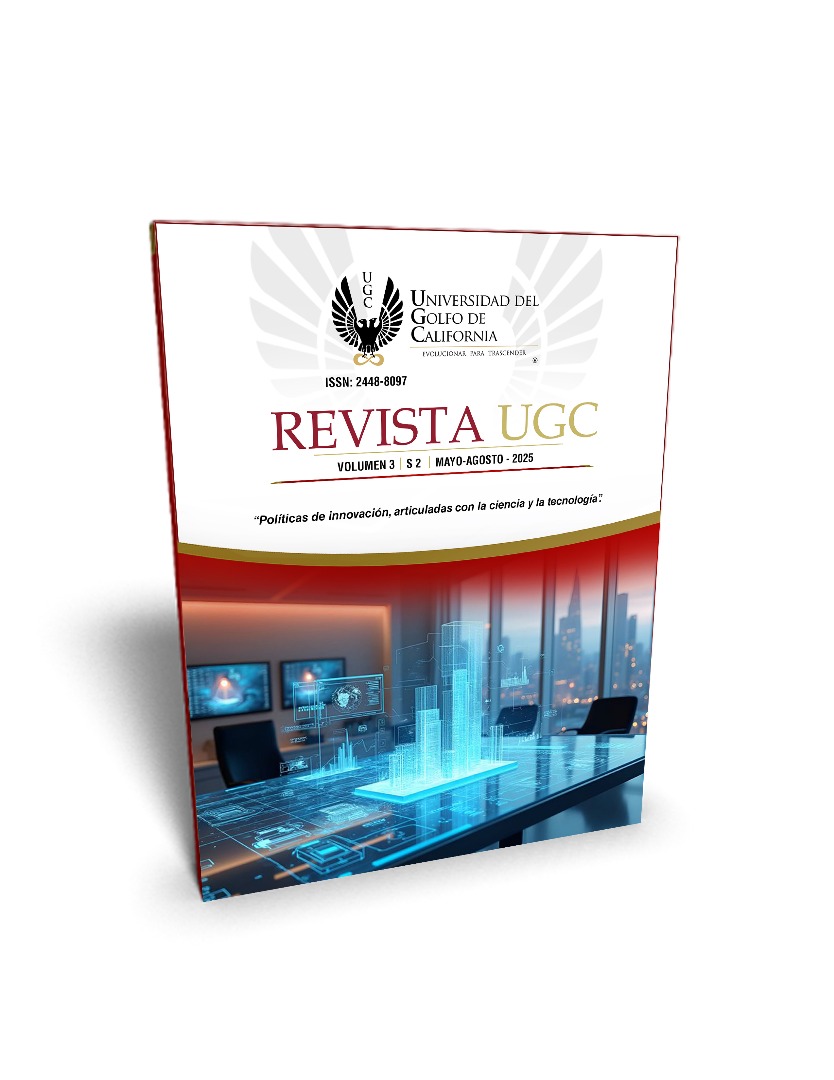
El Consejo Editorial de la Revista UGC, de la Universidad del Golfo de California, tiene el gusto de presentar el segundo número especial del año 2025. Es esta una ocasión para reconocer la importancia de las políticas de innovación, articuladas con la ciencia y la tecnología.
Las políticas de innovación, articuladas con la ciencia y la tecnología, son importantes para vincular los esfuerzos de empresas, gobiernos e instituciones académicas. Esto permitirá fortalecer los sistemas nacionales de innovación; relacionarlos con las principales tendencias que existen a nivel internacional; y generar un mayor impacto en la economía, la sociedad y el medio ambiente.
La innovación tecnológica, impulsada por políticas de ciencia y tecnología fomentan la investigación y el desarrollo. También mejoran la calidad de vida de las personas; fomentan la sostenibilidad; fortalecen el sector público; aumentan la competitividad; promocionan el emprendimiento; crean mecanismos para facilitar la transferencia de tecnología de los centros de investigación a las empresas; apoyan la educación superior con programas para la capacitación profesional del capital humano; y crean alianzas estratégicas entre empresas, universidades, centros de investigación y gobiernos, para desarrollar proyectos innovadores.
De esta forma las políticas de innovación articuladas con la ciencia y la tecnología son fundamentales para el desarrollo sostenible y el progreso social, pues mejoran la calidad de vida de las personas y permiten el crecimiento económico de las naciones.
Downloads
Downloads
Published
How to Cite
Issue
Section
License
Copyright (c) 2025 Dr. C. Jorge Luis León-González

This work is licensed under a Creative Commons Attribution-NonCommercial-ShareAlike 4.0 International License.
Authors who publish in Revista UGC agree to the following terms:
1. Copyright
Authors retain unrestricted copyright to their work. Authors grant the journal the right of first publication. To this end, they assign the journal non-exclusive exploitation rights (reproduction, distribution, public communication, and transformation). Authors may enter into additional agreements for the non-exclusive distribution of the version of the work published in the journal, provided that acknowledgment of its initial publication in this journal is given.
© The authors.
2. License
The articles are published in the journal under the Creative Commons Attribution-NonCommercial-ShareAlike 4.0 International License (CC BY-NC-SA 4.0). The terms can be found at: https://creativecommons.org/licenses/by-nc-sa/4.0/deed.en
This license allows:
- Sharing: Copying and redistributing the material in any medium or format.
- Adapting: Remixing, transforming, and building upon the material.
Under the following terms:
- Attribution: You must give appropriate credit, provide a link to the license, and indicate if any changes were made. You may do this in any reasonable manner, but not in any way that suggests the licensor endorses or sponsors your use.
- NonCommercial: You may not use the material for commercial purposes.
- ShareAlike: If you remix, transform, or build upon the material, you must distribute your creation under the same license as the original work.
There are no additional restrictions. You may not apply legal terms or technological measures that legally restrict others from doing anything the license permits.